

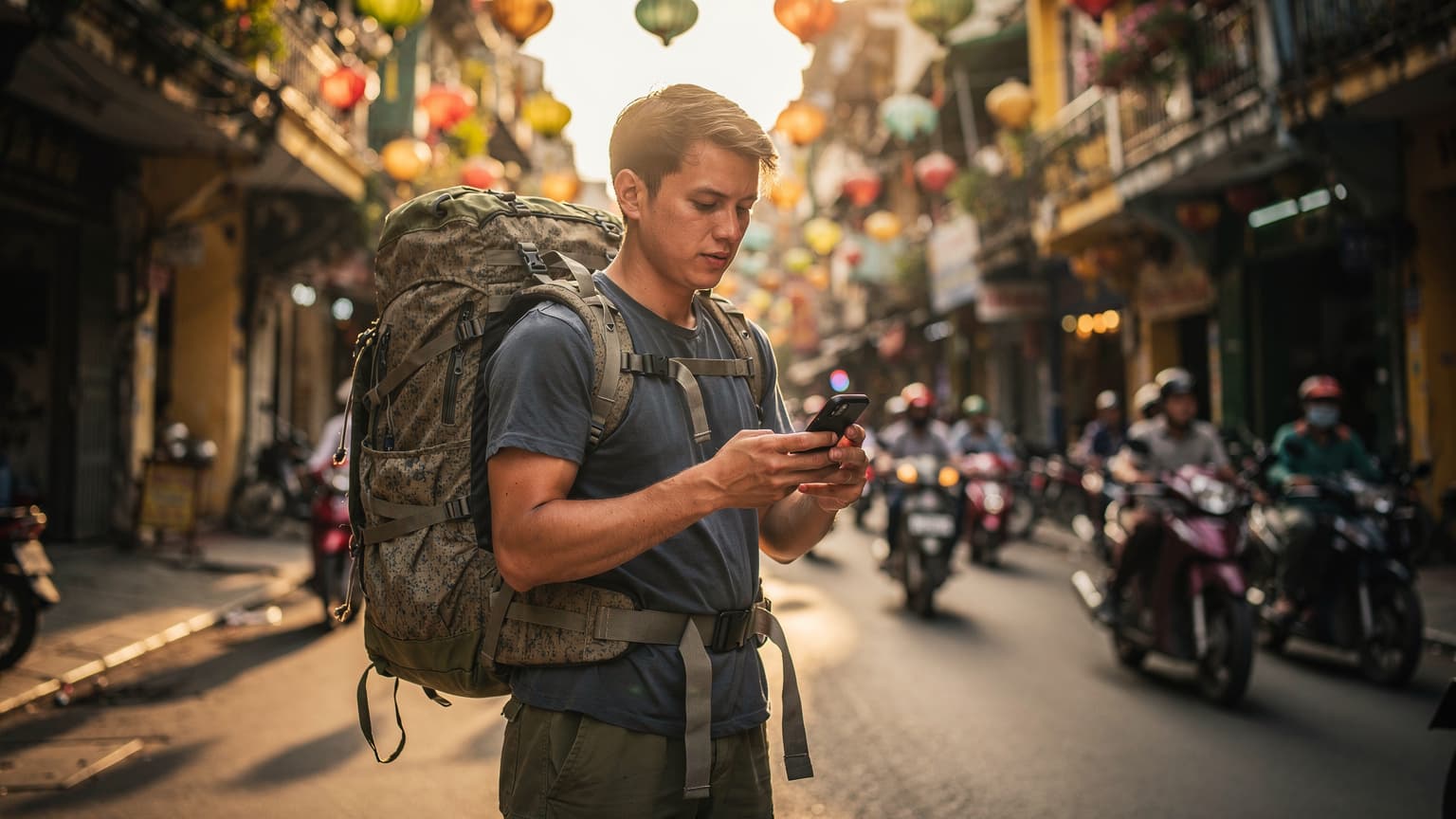
The Hanoi Data Dilemma: Cost-per-GB Showdown
Let's cut to the chase, folks. My recent 8-day trip through Hanoi cost me exactly €280 on data, and that's because I didn't use an eSIM. Don't make my mistake. When I talk about travel, every cent counts, especially in a city like Hanoi where a bowl of pho costs less than a dollar. The choice between a $5 eSIM and a $50+ roaming plan isn't just about convenience, it's about funding another five days of street food or an extra night at the Hanoi Old Quarter Hostel, which, let's be real, is where you want your money going.
For too long, American travelers have been fleeced by their home carriers. T-Mobile's 'free' international roaming, while tempting, often throttles you to 2G speeds, making Google Maps a frustrating exercise in patience. Verizon and AT&T? Don't even get me started on their daily international passes that clock in at $10-15 a day. That's a full meal and a few beers at the Bia Hoi Junction, gone, just for the privilege of checking Instagram. This isn't sustainable for anyone trying to hit that €40/day budget.
The True Price of Connectivity
Forget the headline numbers for a second. We need to talk about cost-per-gigabyte. This is the metric that truly separates the savvy traveler from the one burning cash. A typical 7-day CheapESIM plan for Vietnam usually offers around 3-5GB of data for under $10. That's roughly $1-2 per GB. Compare that to my last T-Mobile bill where I somehow managed to rack up charges at a rate closer to $10-15 per GB for anything beyond their glacial 2G speeds. It's a highway robbery, plain and simple.
Your data usage in Hanoi isn't going to be minimal. You'll be navigating the maze of the Old Quarter, looking up bus routes to Ha Long Bay, booking Grab rides, and sending endless photos of your spring rolls to your envious friends back home. Reliable, affordable data isn't a luxury, it's a necessity for staying safe and efficient.
My Personal Hanoi Data Budget Breakdown
My last trip to Southeast Asia taught me a hard lesson. I spent 10 days in Vietnam, primarily in Hanoi and then a quick hop to Hue. I thought I was being smart by relying on hostel Wi-Fi and downloading offline maps. Big mistake. Trying to hail a Grab in a downpour after the Wi-Fi at my hostel, 'The Note Hostel', decided to quit was a nightmare. I ended up blowing through a $50 Verizon international pass just to get a ride, and that was after two days of trying to manage without.
Let's crunch those numbers. I used roughly 500MB per day on average, mostly for navigation, WhatsApp, and quick social media checks. Over 10 days, that's 5GB. If I had used a $5 CheapESIM eSIM, my total data cost would have been, well, $5. Instead, I paid $50. That's a $45 difference, enough for a solid street food tour, an overnight train ticket with Vietnam Railways from Hanoi to Sapa, or a few dozen refreshing Bia Hois. This isn't theoretical, it's actual money out of your pocket.

What 5GB of Data Really Means in Hanoi
- Navigation: Google Maps, Grab, and local bus apps are essential. They chew through data, especially if you're constantly refreshing your location or searching for new spots.
- Communication: WhatsApp, Messenger, and FaceTime calls home. Video calls, even short ones, are data hogs.
- Research: Looking up opening hours for Hoan Kiem Lake, finding the best banh mi stall on Hang Bac Street, or checking reviews for a night bus operator like The Sinh Tourist.
- Social Media: Posting photos and stories on Instagram, Facebook, and TikTok. It's unavoidable for most travelers, and frankly, part of the fun.
- Emergencies: The peace of mind that comes with knowing you can always call for help, look up medical information, or contact your embassy.
Comparing the Numbers: eSIM vs. US Carrier Roaming
This is where the rubber meets the road. I've broken down what you can expect from different data options for a 10-day trip to Hanoi in 2026. The differences are stark, and frankly, ridiculous.
| Provider Type | Typical Cost (10 Days, ~5GB) | Data Speed Expectation | Pros | Cons |
|---|---|---|---|---|
| CheapESIM eSIM (Vietnam) | $5 - $15 | 4G/LTE (local network speeds) | Extremely affordable, instant activation, reliable speeds, keeps primary SIM active. | Requires eSIM compatible phone. |
| US Carrier Roaming (e.g., Verizon/AT&T) | $100 - $150 ($10-15/day pass) | 4G/LTE (often throttled after daily cap) | Convenient, uses existing number. | Extremely expensive, daily caps, potential throttling. |
| T-Mobile 'Free' Roaming | $0 (for basic data) + add-ons for speed | 2G (basic), 4G/LTE (paid upgrades) | Included with some plans. | Painfully slow without costly upgrades, frustrating for navigation/streaming. |
As you can see, the value proposition is overwhelmingly in favor of an eSIM. When I traveled through Europe a few years back, the SouthESIM was a godsend for keeping my spending low across multiple countries. The principle is the same here in Asia.
Calculating Your Potential Savings
Let's assume a conservative 7-day trip to Hanoi, using 3.5GB of data (0.5GB/day). With a CheapESIM eSIM, you're looking at maybe $5-7. With a US carrier's daily pass, that's $70-105. That's a minimum saving of $65 for just one week! Over a longer trip, say a month exploring Vietnam and Cambodia, those savings quickly climb into the hundreds, potentially even a thousand dollars. That's real money that can be reallocated to experiences, better food, or just stretching your trip further.
The Local SIM Card Alternative: Is It Worth the Hassle?
Okay, I hear you. "Mike, what about a local physical SIM card? Those are usually cheap!" And you're not wrong. For fairness, let's talk about the cheapest local SIM alternative in Hanoi: Viettel. They're the biggest provider in Vietnam, and you can pick up a physical SIM at Noi Bai International Airport (HAN) or any Viettel store in the city.
A typical tourist SIM from Viettel might cost you around 100,000-150,000 VND (about $4-6 USD) for 5-10GB of data over 30 days. On paper, that's fantastic. It's often slightly cheaper per GB than an eSIM, especially if you find a good deal. So, why don't I always recommend it?
The Hidden Friction of Physical SIMs
There are a few reasons why the local physical SIM, despite the low price, often isn't the best option for a short-term, budget-conscious traveler:
- Airport Scams: While not as bad as some other countries, airport SIM kiosks often have inflated prices or try to push plans you don't need. You might get lucky, but it's a gamble.
- Language Barrier: Buying a SIM in a local store means dealing with potential language barriers, especially if you have questions about data caps, top-ups, or activation.
- Time is Money: You land, you're tired, you want to get to your hostel in the Old Quarter (probably 'Hanoi Buffalo Hostel' or similar). Do you really want to spend an hour trying to find a legitimate store, activate a SIM, and potentially troubleshoot issues? Your time is valuable, especially on a tight itinerary.
- Dual SIM Devices: If you have an iPhone with only one physical SIM slot, you have to choose: either remove your home SIM (and potentially miss calls/texts) or carry a second phone. An eSIM solves this neatly by allowing both to operate simultaneously.
- Registration Requirements: Vietnam, like many countries, requires SIM card registration. While usually handled by the vendor, it adds a layer of bureaucracy that an eSIM often bypasses.
For me, the slight cost saving of a local physical SIM card usually doesn't outweigh the convenience and peace of mind of having an eSIM activated before I even board my flight. It's about optimizing your travel experience, not just minimizing a single line item.
Setting Up Your eSIM in Hanoi: A Step-by-Step Guide
This is the easy part, honestly. If your phone supports eSIM (most modern iPhones and Android flagships do, check CheapESIM's FAQ if you're unsure), you can have data running before you even clear customs at HAN. No more frantic searching for Wi-Fi or haggling at airport kiosks.

Pre-Trip eSIM Activation (Recommended)
- Purchase Your eSIM: Go to CheapESIM's website and select a Vietnam-specific plan. For Hanoi, I'd recommend at least 5GB for 10-15 days. You'll get an email with a QR code and instructions.
- Scan the QR Code: Before you leave home, or with reliable Wi-Fi, go to your phone's Settings > Cellular/Mobile Data > Add eSIM/Cellular Plan. Scan the QR code. Follow the prompts.
- Label Your eSIM: Name your new plan something obvious, like "Hanoi Data" or "Vietnam CheapESIM". This helps you keep track.
- Choose Primary Line: Keep your home SIM as your primary line for calls/texts, but ensure your new eSIM is set as the primary for Data Roaming. Turn off data roaming for your physical SIM to avoid accidental charges.
- Arrive Connected: As soon as your plane lands in Hanoi, your phone will connect to a local network (likely Viettel or Mobifone) and you'll have data. No fumbling, no stress.
Post-Arrival Activation (If You Forget)
If you forget to activate before you leave, don't panic. You'll need to find reliable Wi-Fi, which is generally available at Noi Bai airport or most hostels in the Old Quarter. Just connect to the Wi-Fi and follow the same steps above. It might take a few minutes, but it's still far better than hunting for a physical SIM.
Border-Crossing Tactics: Keep Your Data Live
This is where eSIMs truly shine, especially for us backpackers hopping between countries. My budget Substack readers know I'm always looking for the cheapest overland routes, and that often means crossing borders where local SIM options are non-existent or overpriced. Remember that time I crossed from Laos into Thailand at the Huay Xai-Chiang Khong border? Absolutely no reliable data for miles after the Lao side, until I hit Chiang Khong.
Hanoi is a common jumping-off point for land crossings into Laos or Cambodia, like the bus from Hanoi to Vientiane or the infamous 'sleeping bus' to Phnom Penh. These border crossings, particularly the Lao Bảo international border or the Moc Bai border with Cambodia, are notorious for dead zones or opportunistic vendors selling overpriced, unreliable SIMs. An eSIM with regional coverage, like a CheapESIM Asia plan, can save your bacon.

Seamless Transitions Between Countries
If your travel plans include more than just Vietnam, consider a regional eSIM. For example, a plan that covers Vietnam, Laos, and Cambodia means you don't have to buy a new SIM every time you cross a border. This is critical when you're on a long-haul bus that drops you off in the middle of nowhere at 2 AM. I've been there, staring at a blank phone screen, hoping Google Maps had downloaded enough of the next town offline. With an eSIM, as soon as you connect to the new country's network, your data is live, letting you check your hostel booking or call a Grab.
Always check the coverage map for your chosen eSIM plan. Some CheapESIM regional plans cover all of Southeast Asia, which is ideal if you're hitting multiple countries in quick succession. This isn't just about saving money, it's about safety and efficiency when you're in unfamiliar territory.
Maximizing Your Data Budget: Hanoi Edition
Even with a cheap eSIM, you still want to be smart about your data consumption. Every megabyte saved is another few cents in your pocket, or another few minutes of high-speed browsing when you really need it. Hanoi offers plenty of opportunities to conserve data, if you know where to look.
Smart Data Habits for Hanoi
- Offline Maps are Your Friend: Before you head out, download offline maps for Hanoi and any other cities you plan to visit. Google Maps and Maps.me are excellent for this. This way, navigation uses minimal data.
- Wi-Fi Whenever Possible: Most cafes in Hanoi, from the trendy spots in Tay Ho to the local coffee stalls in the Old Quarter, offer free Wi-Fi. Many hostels, like the 'Central Backpackers Hostel' chain, also have decent Wi-Fi. Use these opportunities to download large files, upload photos, or stream video.
- Manage Background App Refresh: Go into your phone settings and turn off background app refresh for apps you don't need constantly updating. Social media apps are notorious for chewing through data in the background.
- Restrict Streaming: Avoid streaming high-definition video on cellular data. If you absolutely must watch something, download it on Wi-Fi beforehand.
- Data Saver Mode: Activate your phone's data saver mode. This will reduce data usage in many apps, often by compressing images and videos.
These small habits add up. On my last trip, I managed to stretch a 5GB plan for almost two weeks by being mindful. It's not about deprivation, it's about smart resource management, something every budget backpacker masters eventually.
The Hidden Costs of 'Free' WiFi
Everyone loves free Wi-Fi, right? Especially when you're trying to save a buck. Hanoi has plenty of it, from cafes to hostels. But relying solely on public Wi-Fi comes with its own set of problems, some of which can be more costly than buying an eSIM.
Why Public Wi-Fi Isn't Always the Answer
- Security Risks: Public Wi-Fi networks are often unsecured, making your data vulnerable to snoopers and hackers. Banking, logging into emails, or anything sensitive should never be done on an open network.
- Unreliable Speeds: 'Free' Wi-Fi is rarely fast Wi-Fi. I've wasted countless hours in cafes trying to upload photos or download a movie, only to give up in frustration. When you're on a tight schedule, this time is valuable.
- Inconsistent Coverage: You can't count on Wi-Fi being everywhere. As soon as you step out of that cafe or hostel, you're back to square one. What if you need directions in a hurry, or your Grab driver can't find you?
- Time Sink: Hunting for reliable Wi-Fi can eat into your precious travel time. Imagine spending 20 minutes walking around looking for a cafe with a strong signal, instead of exploring the Temple of Literature or enjoying a walk around Hoan Kiem Lake.
- Privacy Concerns: Many public Wi-Fi providers collect your data. It might be 'free', but you're paying with your personal information.
For me, a dedicated eSIM is about taking control of my connectivity. It's a small investment for guaranteed speed, security, and consistent access, no matter where I am in Hanoi, from the bustling streets of the Old Quarter to the quieter areas around West Lake.
Final Verdict: eSIM for the Savvy Hanoi Traveler
If you're heading to Hanoi in 2026, and you're serious about your budget, then an eSIM is a no-brainer. It's cheaper, more convenient, and offers better performance than relying on expensive US carrier roaming or the often-unreliable dance of finding local physical SIMs and public Wi-Fi.
My advice is simple: Get your Vietnam eSIM before you even pack your bags. Choose a plan that fits your expected data usage, install it, and land in Hanoi already connected. That $5-15 investment will save you easily $50-100 on a week-long trip, freeing up cash for more banh mi, more coffee, or that extra excursion to Ninh Binh. Don't compromise on connectivity, but don't overpay for it either. Travel smart, stay connected, and enjoy every dollar you save.
Frequently Asked Questions
How much data do I need for a week in Hanoi?
For a typical week-long trip to Hanoi, 3-5GB of data should be sufficient for navigation, messaging, social media, and light browsing. If you plan to stream a lot of video or make frequent video calls, consider a 7-10GB plan.
Can I use my current phone number with an eSIM in Hanoi?
Yes, with an eSIM, you can keep your primary physical SIM active for calls and texts on your home number while using the eSIM for data. You'll simply set the eSIM as your default for cellular data in your phone's settings.
What are the cheapest local physical SIM alternatives in Hanoi?
The cheapest local physical SIM is typically from Viettel, Vietnam's largest carrier. You can purchase one at Noi Bai International Airport or authorized Viettel stores in Hanoi for approximately 100,000-150,000 VND (about $4-6 USD) for 5-10GB of data over 30 days.
Is Wi-Fi widely available in Hanoi?
Yes, Wi-Fi is widely available in Hanoi, especially in cafes, restaurants, and hostels in popular tourist areas like the Old Quarter. However, speeds can be inconsistent and public Wi-Fi networks often lack security, making them unsuitable for sensitive online activities.
What's the difference between eSIM and international roaming from my US carrier?
eSIMs offer local data rates, typically costing $5-15 for several gigabytes over multiple days, providing 4G/LTE speeds. US carrier international roaming often costs $10-15 per day, adding up to $50-150 for a week, and may throttle speeds after daily limits or offer slower 2G data.
Can I use an eSIM when crossing land borders from Hanoi to other countries?
Yes, if you purchase a regional eSIM plan that covers multiple countries, your data will activate seamlessly as you cross borders. This is a significant advantage over local physical SIMs, which are country-specific and often unavailable at remote land crossings.